
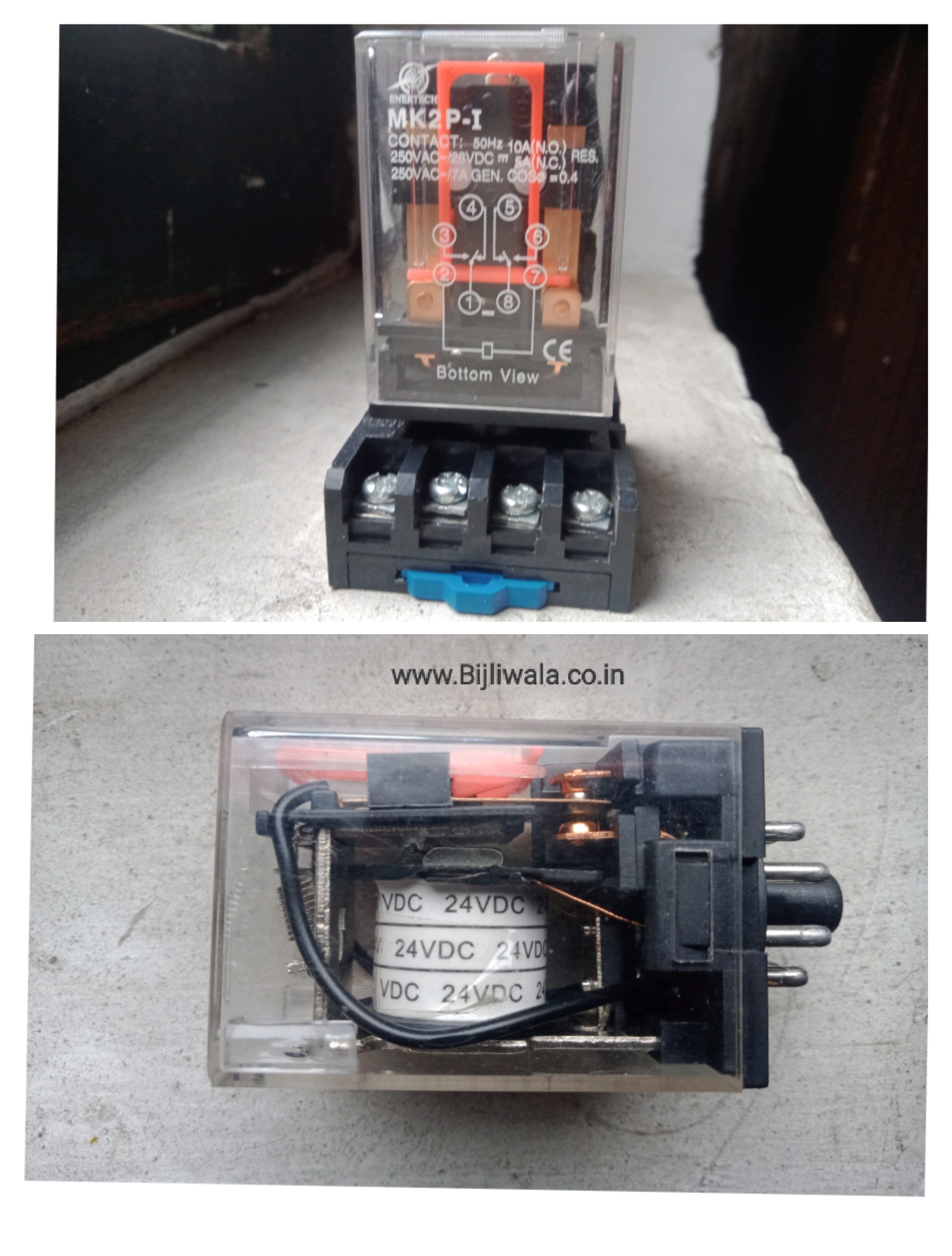
This post is all about Electromagnetic relay In which we will explain its construction, working & Types. But first we need to know why do we need electromagnetic relay ? Why should we use it ?
REASONS, WHY ARE WE USING ELECTROMAGNETIC RELAY ?
1. Different power supplies can get controlled through Electromagnetic relay
In Electrical power system, there are two supplies AC(Alternating Current) & DC(Direct Current).
Whether it is AC or DC; We can not mix the power supplies with each other. We can not mix AC supplies with different phase shifts & also the DC supplies with different magnitude can not be mixed. Each supply has its own flow path or flow circuit. To control another power supply with some another power supply we can use electromagnetic relay.
2. To Isolate one system from another
The output signal of Programmable controllers like PLC’s are soft in nature means these controllers produces output with having a low current rating with load nature resistive in type; mostly. We can’t connect heavy load directly with the outputs of programmable controllers.
With electromagnetic relay, We can control the load indirectly; controller operates electromagnetic relay while relay further controls load output.
3. To control multiple outputs with single input
With electromagnetic relay we can control multiple outputs simultaneously at a same time with only one single input.
ELECTROMAGNETIC RELAY
Electromagnetic relay consists of an electromagnet, NO & NC contacts & mechanical spring mechanism. Due to the spring tension, the contacts remain positioned at its normal state. When an electromagnet get energized, These contacts changes their state, Further when electromagnet get de-energized, the contacts get back to their normal state due to mechanical spring tension.
 |
| 8 Pins Electromagnetic Relay by OMRON Coil 24VDC | Contact Rating 230VAC 10Amps(NO),5Amps(NC)-Resistive |
WORKING OF ELECTROMAGNETIC RELAY
 |
| Symbol of NO contact |
 |
| Symbol of NC contact |
- When electromagnet get energized(Forced state), common contact(3) get break with NC(4) contact & get shifted towards NO(5) contact.
- When electromagnet get deenergized(Normal state), common contact(3) get break with NO(5) contact & get shifted back to NC(3) contact.
 |
| Schematic Diagram of electromagnetic relay when coil is de-energized |
SELECTION OF ELECTROMAGNETIC RELAY
- What is the type of coil’s supply AC or DC & What is the Supply voltage ?
- Which type of contacts do we need NO,NC OR Changeover relay ?
- How much contacts do we need ? OR How much changeover relay we need ?
- What is the current & voltage rating of the contacts?
TYPES OF ELECTROMAGNETIC RELAY
- 14 Pins Electromagnetic Relay
 |
| 14 Pins Electromagnetic Relay by salzer Coil voltage 230VAC | Contact Rating-240VAC/24VDC, 5Amps |
LED as an indication for energized state
14 Pins Electromagnetic Relay by salzer

Terminals of electromagnetic Relay
14 Pins Electromagnetic Relay by salzer

 |
| De-energized State of Electromagnetic Relay 14 Pins Electromagnetic Relay by salzer |
 |
| Energized state of electromagnetic relay 14 Pins Electromagnetic Relay by salzer |
- 8 Pins Electromagnetic Relay
 |
| 8 Pins Electromagnetic Relay by OMRON Coil 24VDC | Contact Rating 230VAC 10Amps(NO),5Amps(NC)-Resistive |
 |
| 8 Pins Electromagnetic Relay by OMRON Coil voltage 230VAC | Contact Rating 230VAC/24VDC,5Amps |
- PCB Mounted Electromagnetic Relay
 |
| PCB Mounted Electromagnetic Relay | Coil voltage 12VDC | Contact Rating 250VAC/28VDC,7Amps |
 |
| Base of PCB Mounted Electromagnetic relay having 1 changeover relay |
 |
| 14 Pins Electromagnetic Relay with 14 pins relay base |
 |
| 8 Pins Electromagnetic relay with 8 Pins relay base OMRON |
DRAWBACKS OF ELECTROMAGNETIC RELAY
- IF compare with Solid State relays; Electromagnetic relays are slow in speed.
- After long use the contacts of the relay get carbonized which further don’t work precisely.
- Different type of Relays has their own base; if we need to change the relay sometime, Relay must be according to the base.
CONCLUSION
- Electromagnetic relays are similar to Contactors which are having a electromagnet, mechanical spring mechanism & electrical contacts. But it is different from contactor because it is designed for small current ratings.
- There are different types of electromagnetic relays but basic function remains the same in ALL. The entire selection of electromagnetic relay depend upon the following parameters.
- What is the type of coil’s supply AC or DC & What is the Supply voltage ?
- Which type of contacts do we need NO,NC OR Changeover relay ?
- How much contacts do we need ? OR How much changeover relay do we need ?
- What is the current & voltage rating of the contacts?
Leave a Reply